20W-50 Engine Oil: What It Is, Which Cars Need It, and When to Use It
You are on your way to Dubai or Abu Dhabi in the middle of summer; the air-conditioning is on full blast, there is barely any traffic, and the temperature outside is over 45°C. It is in such a situation that a single question determines your engine's survival: will your engine oil withstand this heat?
For many drivers in the UAE and the wider Arabian Gulf region, the solution is usually reduced to one of the most relied-upon and popular lubricants in hot climates: 20W-50 engine oil. It is not one of the oil grades on the shelf. It is a highly developed solution suitable for high-heat operating conditions, high engine load, and older or high-mileage cars that require more robust protection.
Knowing what 20W-50 really means and whether you really need it in your car can make a noticeable difference in your engine performance and long-term maintenance expenses.
What 20W-50 Engine Oil Actually Means
The first step to knowing the 20W-50 engine oil specifications is to unlock the numbers. The 20W indicates the viscosity of the oil at cold temperatures, whereas the 50 indicates the viscosity at high operating temperatures.
Simply put, this oil is thicker than low-viscosity oils such as 5W-30 or 10W-40. The thickness is important because it forms a more protective layer between moving engine components, particularly during long periods of engine running at elevated temperatures.
Cold-start performance is included in the rating system, but in areas such as the UAE, it is not freezing temperatures that are the priority. Rather, the focus is on high-temperature engine oil stability, since engines are more likely to be under heat than cold during operation.
Thus, 20W-50 is designed to remain stable and protective even at high engine temperatures during long drives, heavy traffic, and desert conditions.
Why Viscosity Matters More in Hot Climates Like the UAE
The viscosity of engine oil is simply the oil's resistance to flow. Oil naturally thins with rising temperatures in hotter climates like the Arabian Gulf. If it becomes too thin, it will not be effective in protecting parts of the engine, such as pistons, crankshafts, and camshafts.
At this point, 20W-50 oil specifications would be very useful. It has greater viscosity at operating temperature, which means that even at extreme temperatures, the oil will provide a protective coating between the metal surfaces.
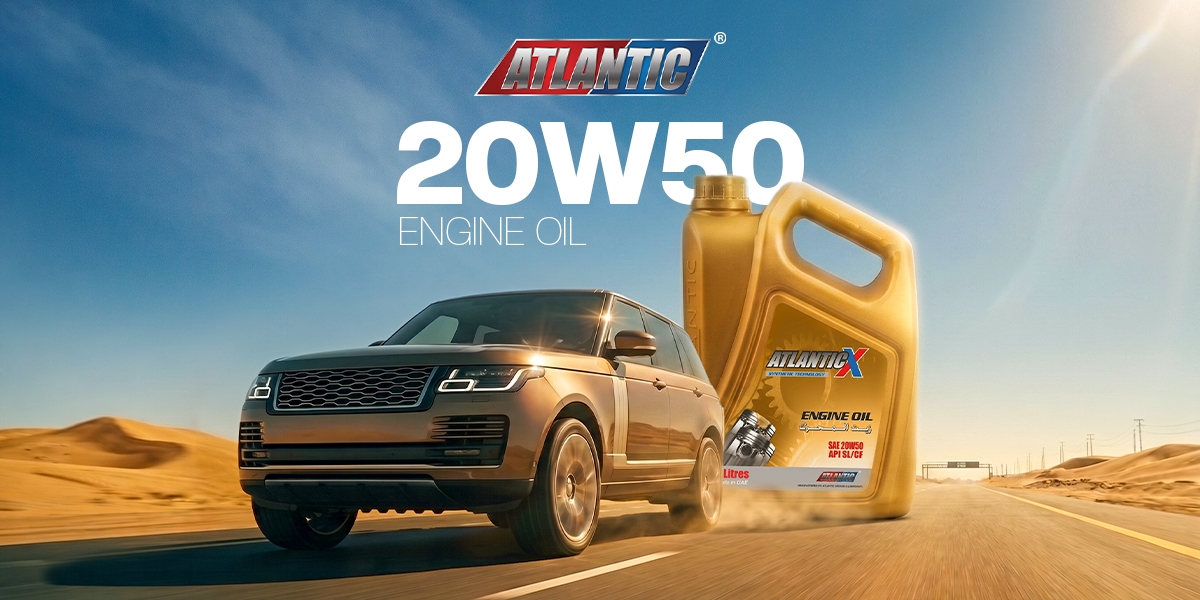
Furthermore, driving conditions in the UAE are not easy. Traffic stop-and-go, sluggish highway speeds, and long periods of idle time all add to engine stress. Consequently, most workshops and mechanics in the area continue to recommend 20W-50 for certain engines due to its lubrication stability even under demanding conditions. If you are looking for a premium quality 20W-50 engine oil, you can try our Atlantic X Engine Oil SAE 20W-50 API SL/CF.
Which Vehicles Benefit Most from 20W-50 Oil
Not all engines are designed for thick oil, yet some types are evidently advantageous to it.
Older cars are the predominant users of 20W-50. Internal clearances naturally wear with engine age. The thicker oil helps maintain compression and consumes less oil. That is why many high-mileage cars in the UAE can still run on this grade.

Likewise, larger engines like SUVs, pickup trucks, and commercial cars usually work well with 20W-50 since they operate at higher loads and temperatures. Under these conditions, the properties of hot-weather engine oil are more crucial than fuel-economy optimization.
Moreover, classic cars and older Japanese, American, or European models, which were originally designed to use pre-modern low-viscosity oil standards, also typically require this grade to be properly protected.
However, this viscosity is typically not recommended for modern turbocharged and fuel-efficient engines unless specified by the manufacturer.
Is 20W-50 Suitable for UAE Weather Conditions?
In short, yes--in the right circumstances, it is most appropriate.
UAE climate is among the most challenging for vehicles. Summers are long, hot, and surface temperatures are high, posing a constant challenge to engine lubrication systems. In these conditions, the stability of engine oil at high temperatures is more significant than cold-start performance.
The reason 20W-50 is good is that it doesn't thin out at high temperatures. This ensures oil pressure and prevents metal-to-metal contact during long drives or in traffic jams.
It is worth noting, however, that present-day engines are becoming increasingly advanced, with thinner oils that are more fuel-efficient and emit less. Therefore, 20W-50 is very good at heat protection, but should never be used outside the engine's design.
When You Should Use 20W-50 Engine Oil
The time to use 20W-50 is not necessarily a weather issue but rather an engine condition and manufacturer's instructions.
When you realize that your vehicle is consuming more oil, there is more engine noise, or the compression is decreasing, switching to a heavier oil, such as 20W-50, can help stabilize your vehicle. Likewise, when you drive an older car in extreme heat conditions, this type of oil can provide better protection.
It is also commonly used in the Gulf region, including commercial fleets and work vehicles, as they operate under continuous loading and extended hours of operation.
On the other hand, when your car is new or needs low-viscosity synthetic oil, 20W-50 can make your vehicle less efficient and place undue stress on engine parts. Thus, compatibility is always a priority.
Comparison With Other Oil Grades
The 20W-50 is much thicker than other lighter oils such as 5W-30 or 10W-40 at operating temperature. It implies enhanced resistance to heat, but a little more internal resistance.
As a result, the fuel economy could be reduced and the engine reaction can be a bit heavier in the modern engines that are designed for low-viscosity oils.
But in exchange, drivers achieve a greater strength of lubrication film and better wear protection in older engines. This trade-off is precisely why the choice of engine oil viscosity is so critical- it is a matter of aligning the behavior of oil with the engine design and driving conditions.
Why 20W-50 Still Remains Relevant in Modern Markets
Despite the high level of synthetic oils and modern formulations, 20W-50 is still retaining a position in the UAE automotive market. This is because the conditions of the real world are not necessarily the same as those of the engine design in a laboratory.
Numerous vehicles on Gulf roads are still older models and many engines in the Gulf roads are under tremendous heat pressure every day. A stable and thicker oil offers peace of mind and dependability in such instances.
Choose Atlantic Grease and Lubricants for Trusted Engine Protection
Oil quality is not an area to be compromised when it comes to engine performance in extreme climatic conditions such as the UAE. Atlantic Grease and Lubricants has established a reputation of providing high performance and dependable lubrication products that are designed for demanding working conditions.
Our engine oils are designed with regard to thermal stability, wear protection and long drain performance, which makes them a reliable option for the drivers who want to have a consistent engine health. Atlantic products are relied upon in the automotive and industrial markets with a solid belief in quality control and industry standards.
In need of a high-performing engine protection during heat, loading and long-distance driving, Atlantic Grease and Lubricants has a solution that is designed to withstand the Gulf driving conditions.