ATF vs CVT vs DCT Fluids: Understanding Modern Transmission Fluids
The vehicles made nowadays are advanced, and so are their transmission mechanisms. Whether you are cruising in a Nissan Patrol around Abu Dhabi, a Toyota Corolla in Dubai, or a luxury sedan in Sharjah, your car depends on one essential element: the fluid. Nonetheless, transmission fluids are not all the same. Knowledge of the differences between ATF, CVT, and DCT fluids can help you make better maintenance and preventive maintenance choices, extending your vehicle's life.
What is Transmission Fluid?
Transmission fluid is a lubricant specifically designed to ensure your transmission system performs as expected. It performs certain basic functions, such as lubricating moving parts, reducing friction, cooling them, and ensuring proper gear shifting.
In automatic and advanced transmissions, the fluid also serves as a hydraulic medium that transfers power throughout the system. So, selecting the correct type of transmission fluid is not only a maintenance procedure but also a significant performance and durability issue.
Why Transmission Fluid Is Important
The transmission system is complicated, and it operates under high pressure and temperature. This is especially true in the UAE, where driving can cause car wear and tear due to extreme heat and long distances to the destination.
A lack of suitable transmission fluid may cause components to overheat, leading to increased friction and, consequently, failure. In addition, fluid in poor or incorrect condition may cause shifting to be slow and jerky, or even cause the entire transmission to fail.
Periodically maintaining and using the proper fluid would guarantee a smoother ride, better fuel economy, and a longer transmission life. It is therefore one of the most vital yet neglected parts of vehicle care.
Types of Transmission Fluids Explained
Below are the types of transmission fluids:
Automatic Transmission Fluid (ATF)
The most widely used transmission fluid type is ATF, used in traditional automatic transmissions. It is designed to withstand hydraulic pressure while providing lubrication and cooling.
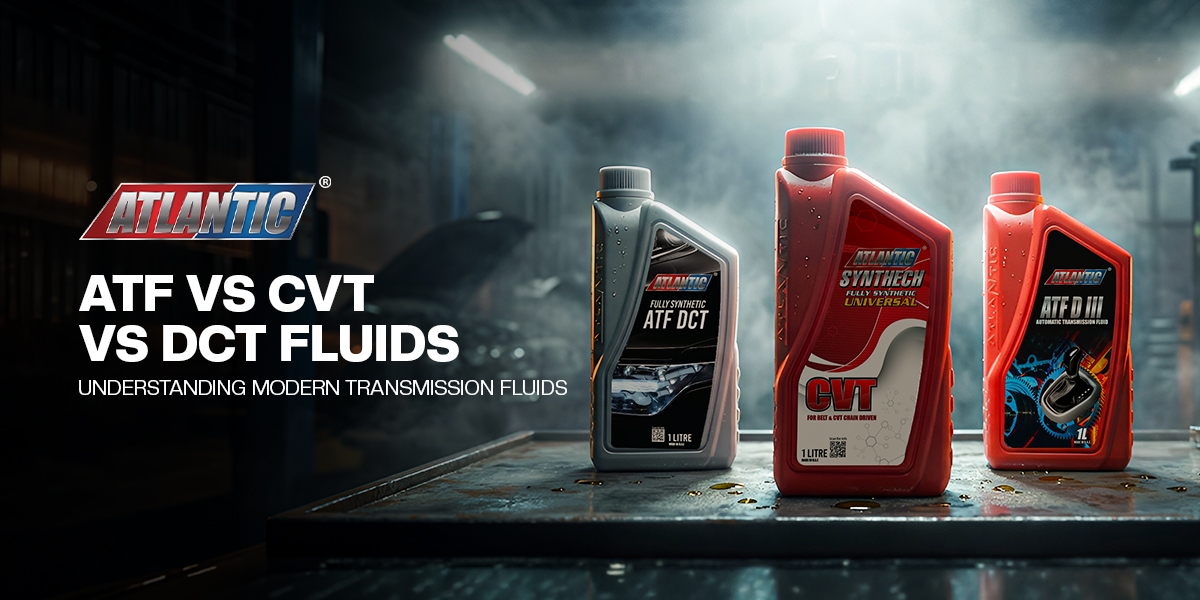
ATF is usually red and contains additives that prevent oxidation and abrasion. ATF is still a common choice in many vehicles in the UAE, and, most importantly, in older models and SUVs, which are also very reliable and versatile. You can try our Atlantic Synthetic ATF D VI for a smooth transmission.
CVT Fluid
Continuously Variable Transmission (CVT) systems are gaining popularity for their smooth acceleration and fuel efficiency. CVTs, however, demand a specialized fluid.
CVT fluid is designed to sustain constant friction between belts and pulleys. It should have a specific coefficient of friction that is neither too high nor too low, to ensure smooth operation, unlike ATF. Thus, it can be seriously damaged if the wrong fluid is used in a CVT. For a universal CVT fluid, you can give a try to our Atlantic Synthech Universal CVT Fluid.
DCT Fluid
The Dual-Clutch Transmission (DCT) is a common transmission in performance and luxury cars. The transmissions integrate the effectiveness and ease of manual gearboxes with the ease of automatics.
DCT fluid is designed to withstand high pressure and rapid gear shifts. It should offer excellent thermal stability and friction control, particularly when driving aggressively, as witnessed on UAE roads.
Manual Transmission Fluid
Manual transmissions are filled with either gear oil or special manual transmission oil. Such fluids are more viscous than ATF and are intended to address direct mechanical contact between gears.
Even in newer UAE vehicles, though the number of manual transmissions is lower, it remains very common in commercial and older vehicles. Adequate lubrication is necessary to prevent gear wear and ensure smooth shifting.
ATF vs CVT vs DCT Fluids
Understanding the differences between these fluids is crucial for proper maintenance. Each type is designed for a specific transmission system and cannot be interchanged with others.
As shown above, each fluid serves a unique purpose. Therefore, using the correct type is essential for maintaining your vehicle’s performance and avoiding costly repairs.
How to Choose the Right Transmission Fluid
To select the right transmission fluid, one must first know one's vehicle's specifications. Always consult your owner's manual because the manufacturer will tell you what type of fluid to use.
In the UAE, driving conditions add another layer of importance. Fluids deteriorate more at higher temperatures. Thus, it is important to choose high-quality fluids that do not easily heat.
This is where Atlantic Grease and Lubricants stand out. Atlantic is a reliable supplier in the UAE and offers premium transmission fluids that work under extreme climatic conditions. They create their products in accordance with international standards and consider the specific issues of the Middle East driving environment.
Moreover, it is advisable to consult a professional lubricant specialist or mechanic and ensure you are using the right fluid in your car.
Signs You Need a Transmission Fluid Change
It is important to notice the early signs before they cost you a lot in repairs. Delayed or rough gear changes are among the most frequent indicators. If your car is reluctant to shift gears, it might be due to degraded fluid.
The other symptom is unusual sounds, such as grinding or whining. These usually indicate insufficient lubrication. Likewise, excessive heat or a burning smell will indicate that the fluid has broken down.
A major indicator is fluid discoloration as well. New transmission fluid is normally clear and light in color, whereas old fluid is dark and dirty. A hot climate in the UAE can exacerbate such issues more quickly, and thus regular checks are even more significant.
Final Thoughts
The importance of transmission fluid is that it helps maintain your vehicle, even in harsh conditions. Understanding the differences between ATF, CVT, and DCT fluids can help you make a wise choice and save your investment.
In a place like the UAE, where vehicles may be overstressed by heat and road conditions, it is important to use high-quality fluids. Picking a reputable supplier, like Atlantic Grease and Lubricants, ensures you get products that meet both global standards and local demands.
Finally, with proper maintenance, the right fluid, and time, it is possible to prolong your transmission's life considerably, save time and money, and avoid undue stress on the road.